
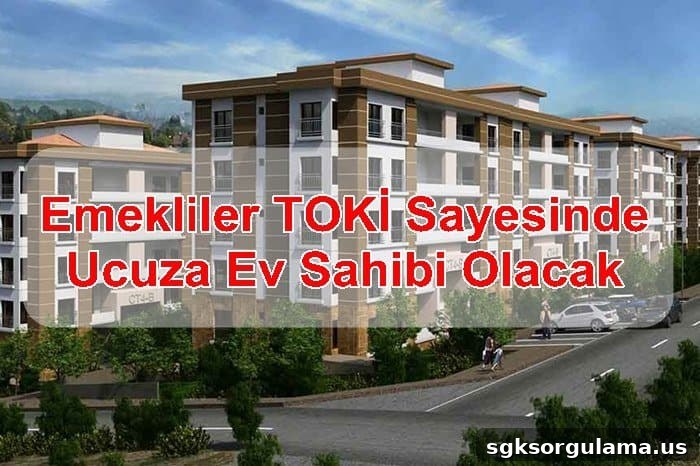
Owning a home remains a top hope for many citizens, and TOKİ housing projects continue to bring good news to retirees and those seeking their first home. Thanks to affordable payment plans, TOKİ enables many people to buy a house in 2018. Interest in TOKİ projects remains strong this year as well. The government has clearly published the application requirements that retirees and others have been asking about under the announcement “Good news from TOKİ for retirees.”
Since TOKİ announcements also include projects planned for 2019, you may want to consider applying for upcoming developments. As one of the main drivers of mass housing construction, TOKİ ensures the delivery of healthy, durable homes. These units attract great interest because they are offered to those in need with easy payment terms.
How Can Retirees Apply to Become Homeowners Through TOKİ?
There are several eligibility requirements for retirees who want to buy a TOKİ home. The main conditions to apply for a project are:
- Applicants must be Turkish citizens.
- The applicant must have lived for at least one year in the province or district where the project is located and must be registered in that province’s population registry. (For example, an Istanbul TOKİ application requires registration in Istanbul’s population records.)
- The applicant must not have previously purchased a residence from TOKİ and must not have used a housing loan from the Mass Housing Administration.
- The household’s total monthly income must not exceed 4,500 TL. Household income is calculated including the applicant’s spouse and children, as well as any assistance they receive. For Istanbul, the monthly household income limit is 4,800 TL.
- Neither the applicant nor any household member may own an individually titled residential property. However, shared ownership (co-owned shares) of real estate owned by the applicant will not count against eligibility.
- If both spouses are retirees, only one household member may apply under the retirees’ category.
- The applicant must be retired from the Social Security Institution (SGK). If the retiree has died, only the surviving spouse may apply.
What Documents Are Required to Apply to TOKİ?
Applicants should include copies of their ID and the Retirement Identity Document issued by the Social Security Institution (SGK) in their application file. If a Retirement Identity Document is not yet available, a letter from SGK confirming retirement status will suffice. These documents are required only at the application stage; additional documents will be requested as the application process advances.
Winners of the lottery must present the required documents. The primary documents requested include an official population registry record (vukuatlı nüfus kaydı) from the provincial or district population directorate and proof of having resided in the province for at least one year. The land registry office (Tapu Sicil Müdürlüğü) must provide a statement confirming that neither the applicant nor the spouse or dependent children holds title to an individually owned property. Proof that the household income does not exceed 4,500 TL must also be documented.
Applicants must include SGK pension payment statements among their documents, and a bank statement showing receipt of the pension will be requested. Income-proof documents may be requested for both the applicant and the spouse. Additional documents may be required if deemed necessary by TOKİ.
What Should Applicants Pay Attention to When Filling Out the TOKİ Application Form?
Applicants to TOKİ projects in İzmir should ensure they meet the conditions for the specific projects carried out by the Mass Housing Administration in İzmir. While living for at least one year in the province and district where the project is located is an important requirement in many cases, this rule does not always apply—especially in certain sales or lower-income projects—so requirements can vary by project.
Recipients of lower-income and social housing who sign their contracts are prohibited from transferring ownership until their debt is fully paid. Until the debt is cleared, the buyer and household members must occupy the residence. If it is determined that the buyer, the buyer’s spouse, or dependent children do not live in the property, the contract may be cancelled.
When completing the TOKİ application form, be sure to fill in all information accurately. The title deed information must correspond to the person who will hold the deed. If you cannot verify the accuracy of the information provided on the form, your application may be canceled. Providing false information is forbidden; in such cases, any down payment or installment payments already made will be refunded without interest.
Into How Many Categories Are TOKİ Applications Divided?
TOKİ organizes applicants into categories that affect eligibility and selection. The main categories are:
- Category 1: Martyrs’ families, widows, orphans, and veterans with service-related disabilities.
- Category 2: Citizens with at least 40% disability.
- Category 3: Retirees.
- Category 4: Other applicants.
Lottery drawings prioritize certain categories. Priority is typically given to the first category (martyrs’ families, widows, orphans, and veterans with service-related disabilities). A quota equal to 5% of the available units is reserved for people with disabilities. Applicants who pay the TOKİ application fee and qualify for the lottery are entered into subsequent draws when applicable.
Reports indicate that 25% of available units may be reserved for retirees, offering hope to many. Those who do not qualify in the first three categories will be included in the fourth-category draw and have another chance at selection. After meeting the eligibility requirements, you can submit your application—either online or by delivering documents to TOKİ regional or central offices.
What Are TOKİ Application Fees?
One of the most frequently asked questions about TOKİ projects, especially those aimed at lower-income buyers, concerns the application fee. TOKİ collects pre-application fees that vary by project and applicant income group. Pre-application fees are typically set at amounts such as 2,000 TL, 3,000 TL, or 5,000 TL; applicants who pass the lottery may proceed to purchase a home.
If an applicant is not selected in the lottery, a waiting list is created. Contracts are offered to applicants on the reserve list when original winners do not sign the sales contract within the specified period. The contract signing period usually lasts between one and two months. If a reserve applicant who has not signed the contract requests a refund, they may apply to TOKİ with their payment receipt. Applicants requesting a refund will not have the right to sign a contract. Refunds are processed after the contract period ends.
What Is the TOKİ Lottery and How Does It Work?
When TOKİ announces a project, the housing units are publicized before sale, attracting widespread interest. Announcements appear in local papers and on official channels, generating large numbers of applications. TOKİ uses several sales methods to allocate homes fairly. Main sales methods include:
- Lottery-based sales
- Open sales
- Sales by auction
- Sales specifically for the poor and lower-income groups
- Revenue-sharing projects
- Sales for public institution personnel without homes
In 2018, the number of TOKİ applicants increased, and many were allocated homes through the lottery method. Each sales method may require different documents and conditions.
How Are TOKİ Lottery Results Announced?
The TOKİ lottery—known as the “right to purchase and housing determination lottery”—is commonly used to ensure fairness, especially when the number of applicants exceeds available units. Lotteries are conducted under notary supervision. If the number of applicants is equal to or less than the available units, there is no need for a lottery; all applicants gain the right to purchase, and selection priority follows application order. Typically, down payments range from 10% to 25% and repayment terms span 8 to 10 years. Monthly installments may start as low as 125 TL, with increases aligned to public servant salary increases and inflation indices, making payments manageable for families.
How Can Application Fees Be Refunded?
Information about refunds for TOKİ application fees is provided in the TOKİ Housing Acquisition Guide. Application fees are refundable to applicants who are not drawn in the lottery or who do not meet TOKİ conditions. If a project cannot proceed for any reason or there is insufficient demand, TOKİ will refund payments in accordance with a determined payment schedule. Applicants who cannot prove eligibility will also have their fees refunded.
If an applicant withdraws after applying, they may lose their rights. In certain cases—such as when auction procedures begin based on demand—an applicant who withdraws may not be able to reclaim fees even if they have been paid; this clause can be included in the contract. If a contract is canceled, the application fee and down payment are refunded without interest, although tax commissions may not be refunded. You can obtain details about cancellation and refunds from your local TOKİ office.
Which Mass Housing Projects Were Announced for 2018?
TOKİ released its 2018 projects, including many provinces such as Istanbul. TOKİ aims to build 1.2 million units by 2023 and continues toward that goal. In January 2018, TOKİ launched projects in five provinces and put a total of 777 units up for sale. Key projects included:
- Adana: 427 units planned in 2018, offered by open sale with 2+1 and 3+1 layouts.
- Kırşehir: A project with 991 units, including 2+1 and 3+1 homes.
- Muş: A 237-unit project to be allocated by lottery.
- Trabzon: A two-stage project with 41 units in total.
- Yozgat: A project of 81 units, 57 of which are reserved for the lower-income group and 27 for the middle-income group, offered by open sale.
What Are TOKİ Payment Terms?
TOKİ payment plans vary by category. With long-term financing and favorable terms, TOKİ helps many citizens become homeowners—often with payments similar to rent. Payment structures are determined by income groups and the project category.
Payment Conditions for the Poor Group
For the poorest group, no down payment is required. Installment payments begin after the handover of the residence; no payments are collected before delivery. Monthly installment amounts are specified in the application announcement. These homes can be financed over 20 years with installments starting from around 100 TL. Installments increase twice a year and are adjusted according to inflation indices (ÜFE and TÜFE) and in line with pension increases; the first adjustment is determined relative to the handover date.
Payment Plan for Lower-Income Group Homes
Payment options for the lower-income group differ. A down payment of 2,000 TL is typically required. Installment payments begin after signing the contract. Monthly installments for a 15-year term start at around 200 TL and are adjusted twice a year (January and July) in line with inflation indices.
Payment Plan for Lower-Middle and Middle-Income Groups
For the lower-middle and middle-income groups, unit sizes range from approximately 75 to 130 square meters. Commonly a 10% down payment is required, with the balance spread over an 8-year term. Alternative plans include 15% down with 9 years of installments or 25% down with 10 years of installments. Exact monthly payments are specified in the project announcement.
Buyers who obtain units under the retirees’ category cannot transfer ownership until their debt is fully paid. Be careful not to provide false information and read contract terms carefully. TOKİ has stated it will continue projects into 2019 and remains committed to helping more citizens in need become homeowners.