Driver’s License for People with Disabilities: Eligibility & Guide
There are many drivers on the road in our country. Every person who drives a vehicle is required to obtain a driver’s license. Before receiving a license, applicants must pass both theoretical and practical exams; those who achieve satisfactory scores become eligible to obtain a license. Recent regulations have also granted the right to obtain a license to citizens with disabilities. In this article we provide information about disabled driving licenses. First, let’s look at the different license classes.
- A1, A2 Class License: Motorcycles
- B Class License: Passenger cars, minibuses
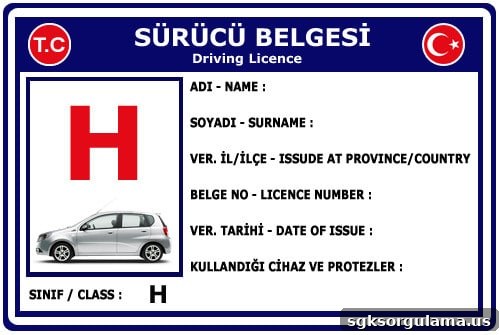
- H Class License: For drivers with disabilities
- C Class License: Trucks, light trucks, passenger cars
- D Class License: Tractor-trailers, trucks, light trucks, passenger cars
- E Class License: Buses, trucks, light trucks, passenger cars
What Is a Disabled (H) License?
The H license is a type of endorsement issued for drivers with disabilities. To obtain this endorsement, applicants must meet certain conditions. The minimum age for obtaining a license is 18, and this age requirement also applies to the H endorsement. The H class is not a standalone license category; rather, it is an endorsement that disabled drivers obtain in addition to their primary license class. For example, a driver who qualifies for a B class license will also obtain the H endorsement and then begin driving with that combination.
During the exam process for this endorsement, applicants with disabilities take the practical test using a specially adapted vehicle. It is important to note that holders of the H endorsement are not permitted to drive commercial (for-hire) vehicles.
How to Obtain a Disabled (H) License
Applicants seeking the H endorsement must first obtain a medical report documenting their disability. The report must not indicate any condition that would disqualify the person from receiving the endorsement. Before receiving the endorsement, candidates also take a theoretical exam. Afterwards, they receive practical training in specially adapted vehicles and, if eligible, take the practical driving test. The duration and format of these exams are generally the same as for other drivers.
There are some exceptions. Individuals who previously held a driving license and later became disabled due to an accident or illness are not required to retake the written exam; they only need to take the practical driving test in a specially adapted vehicle. The minimum age requirement remains as stated above, and the minimum education requirement is completion of primary school.
Theoretical and Practical Exams for the H License
The theoretical exam for this endorsement covers topics such as traffic rules, first aid, and basic vehicle mechanics. As with standard tests, candidates answer a set of 50 questions. Practical driving tests are also an important part of the process. For example, a hearing-impaired applicant may be accompanied by a trained specialist during training and testing; the specialist uses specific techniques to communicate the required information.
Disability Percentage and Eligibility
When applying for the H endorsement, the specific disability percentage is not the determining factor. Instead, the key requirement is that the medical report indicates the applicant is eligible to receive the H endorsement. The types of vehicles a person is authorized to drive depend on the wording of that medical report. For instance, if the report states the applicant may drive only specially adapted vehicles, the H endorsement will be valid for those vehicles only. It is important to pay attention to the details of the medical report.
Tax-Exempt Vehicle Purchase for Disabled Drivers
Another important consideration after obtaining the H endorsement is vehicle taxation. Disabled citizens with a disability rating of 90% or higher are exempt from the Special Consumption Tax (ÖTV) when purchasing a car. Those with a disability rating below 90% may qualify for ÖTV exemption provided the vehicle is fitted with special adaptive controls or modifications. If a vehicle includes such specialized equipment, it is generally restricted to use by the person registered for the disabled license and vehicle registration; family members are not permitted to drive a vehicle equipped with adaptive controls registered to the disabled driver. If no special equipment is installed, other authorized drivers may operate the vehicle.