

Restructuring General Health Insurance (GSS) premium debt is an important matter for citizens who receive health services under the GSS system. The recent arrangement for GSS premium debt restructuring is encouraging, as it cancels interest charges on outstanding debts. Before explaining the restructuring process, it is useful to summarize what GSS is and how its liabilities arise.
What Is GSS Premium Debt?
On January 1, 2012, Article 60 of Law No. 5510 on Social Insurances and General Health Insurance was revised to make general health insurance mandatory. All Turkish citizens were included in the insurance scheme. Individuals residing in Turkey who do not have other insurance, retirement or social assistance coverage, who are over 18 and are no longer covered under a family member’s policy, enter the GSS system.
When an individual joins the system, the GSS premium becomes effective at the end of the first month. Even people who never use health services are obligated to pay this premium; receiving care does not change the obligation. The premium accrues monthly regardless of whether the person chooses to use services.
If a monthly premium is not paid, interest begins to accrue when the second unpaid month arrives. Interest accumulates at the end of each unpaid month. Individuals who do not pay their premiums for a total of 60 days lose access to health services.
If a person without any insurance starts a job, their employer becomes responsible for paying the GSS premiums from that point forward.
How to Check GSS Premium Debt?
You no longer need to visit SSK offices and wait in line to get accurate information about your GSS premium debt. You can view your GSS premium debt on e-Government by logging in with your identity number and password. After logging in, type “GSS prim borcu sorgulama” in the search field to find the relevant service.
Clicking the GSS Premium Debt Inquiry option will show you all accumulated and paid transactions to date.
How Is GSS Premium Debt Calculated?
Those who want to determine the current status of accumulated debts can calculate the remaining debt using the Domestic Producer Price Index (Yİ-ÜFE). The Yİ-ÜFE method provides a definitive result for past-due debts.
When Do GSS Premiums Start?
GSS premium obligations begin when individuals who were covered under family social support lose that coverage upon reaching adulthood. For example, premiums for high school students start at age 20 and for university students at age 25 if they have no employment. In such cases, the obligation begins from the first month after losing family coverage.
If a person is employed, their employer pays the insurance premiums. Unemployed individuals must pay their own premiums. Another common question concerns when premium obligations begin after leaving a job.
When employees leave a job, they and their dependents can continue to use insured health services for 10 days after the insurance end date. This 10-day courtesy applies to people who have up to 90 days of unpaid GSS premiums within a year. Individuals who have paid for 90 days of coverage under certain conditions can extend access to services for an additional 100 days. Therefore, regularly paying GSS premiums helps provide longer access to services in periods without active insurance.
How Much Is the GSS Premium?
GSS premium amounts change with adjustments to the minimum wage. For example, the annual update increased the 2020 premium of 88.29 TL to 107.32 TL in 2021. When a person’s gross minimum wage exceeds a certain threshold, the GSS premium rate is set at 3% of the minimum wage. Premium amounts are determined according to these rules and annual changes.
How Is GSS Premium Debt Paid?
If you choose to pay the remaining debt as a lump sum under the Yİ-ÜFE arrangement, 90% of the calculated debt is forgiven. If you prefer to pay in two installments, 50% of the calculated amount is forgiven.
Where to Pay GSS Premium Debt?
Those responsible for paying GSS premiums can query their debts on e-Government to learn the amount and payment options. Several methods are available for payment.
You can pay via the SGK card payment system or with a credit card through banks that have agreements with the state.
The following banks are among those you can use to pay your GSS premium:
- Akbank,
- Alternatif Bank,
- Albaraka Türk Participation Bank,
- Aktifbank,
- Anadolu Bank,
- Citibank,
- Denizbank,
- Finansbank,
- Fibabanka,
- HSBC Bank,
- Halk Bank,
- ICBC Turkey Bank,
- ING Bank,
- İş Bank,
- Kuveyt Türk Participation Bank,
- Odeabank,
- Şekerbank,
- Türk Ekonomi Bankası (TEB),
- Yapı ve Kredi Bank,
- Burgan Bank,
- Ziraat Bank,
- and others for completing GSS premium payments.
If you are a customer of any of these banks, you can pay via their websites, ATMs or mobile banking apps without taking a loan—using the bank’s payment facilities. The available payment points and methods can be checked on e-Government or with your bank.
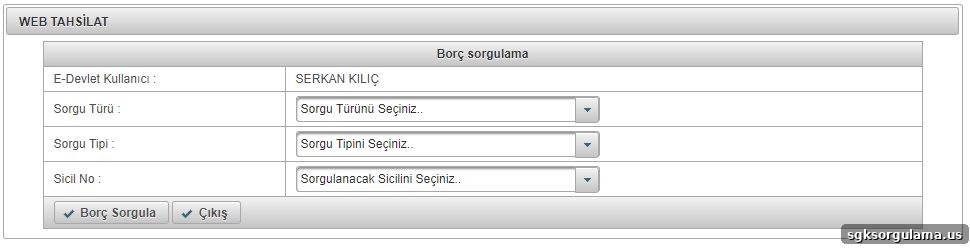
To pay GSS with a credit card, you must first have an e-Government password. After entering the SGK card payment page, log in with your ID number and e-Government password to reach the payment screen.
On the payment screen, choose the “OTHER Collections and Query Type” option. The GSS Premium menu will appear.
Enter your card details accurately to complete the payment. A person can only pay their own debt with a credit card; payments on behalf of another person are not accepted.
You can also pay at ATMs of the listed banks. Select SGK Payments, then GSS Premium Debt Payments, and enter your ID number to proceed. PTT ATMs and PTT branches can also be used to deposit GSS premium payments in the same way.
What Happens If GSS Premium Debt Is Not Paid?
The state initially issues warnings for overdue GSS debts. If the debt remains unpaid, the Social Security Institution may initiate enforcement and garnishment proceedings. If legal action follows and the debtor loses, they are also responsible for attorney fees and related costs.
Nonpayment results in restricted access to health services. Once the full debt is paid, service access is restored, but partial payment does not reinstate benefits. These consequences arise when GSS premiums are not paid as required.
How to Appeal a GSS Premium Debt?
Changes in premiums and retrospective calculations over the years can cause errors that show debts as unpaid when they were paid, or vice versa. In such cases, individuals should visit their local SGK office and request a recalculation of their debt. If an error is found, they can file an official GSS premium debt objection.
After an objection, SGK will review the case. If the claimant is correct, the incorrectly recorded debts are removed. Another route is requesting a means test (income test) through the Social Assistance and Solidarity Center. If the income test shows that the per-person household income falls below the specified threshold, registered debts may be canceled and family members can benefit from GSS without charge.
Note that debt cancellation related to an income test applies from the test date onward; previous debts incurred before the test may not be automatically erased. If a person has not received any notification about outstanding debt and enforcement procedures begin, they should visit the local SGK office to declare that no notice reached them. This declaration can be made in writing and verbally.
Individuals without social security can be covered ex officio under code 60/g (those entitled to benefit from health services without paying GSS premiums). If a person should have been directed to an income test and included under GSS but received no notification, they can appeal any resulting debt. If the appeal is accepted, past debts up to that point can be removed. If SGK did issue the notification but it did not reach the individual, debts are typically removed from the date of the income test application, not retroactively from the beginning.
How Is GSS Premium Debt Canceled?
If someone previously completed an income test and later experiences a decline in financial situation, they may apply for a new income test. If the recalculated per-person household income falls below one-third of the minimum wage, they become eligible for free health services and their debt can be canceled. A new debt will not automatically arise, and the person’s outstanding balance can be reset under the conditions set by the income test.
How Is GSS Premium Debt Restructured?
Many people with accumulated premium debts awaited an arrangement to facilitate payments. A recent announcement offered payment relief for retrospective debts, allowing citizens to begin paying remaining amounts through their chosen bank.
How to Installment GSS Premium Debt?
People who cannot pay the full amount at once may prefer installment plans. There is no permanent law providing installment payments; however, under Article 48 of Law No. 6183 on the Procedure for the Collection of Public Receivables, eligible debts can be scheduled in installments and registered.
Eligible debtors may choose installment plans of 6, 9, 12, or 18 payments. Installments are paid every two months, and the maximum duration allowed is equivalent to 18 installments. Because payments are collected once every two months, selecting an 18-installment plan means payments continue over a longer calendar period—for example, an 18-instalment plan results in a 36-month payment span.
The coefficients applied to installment choices are as follows:
- 6 equal installments: coefficient 1.045,
- 9 equal installments: coefficient 1.083,
- 12 equal installments: coefficient 1.105,
- 18 equal installments: coefficient 1.15.
Those who applied for the 2018 restructuring law and still have unpaid installments can also restructure the remaining installment amounts under the new arrangement.
For more detailed guidance on GSS premium debt restructuring, including individual rights and the steps to follow, consult official SGK resources or your local SGK office.