

The additional service time allowance for arduous work (fiili hizmet süresi zammı) is a regulation that benefits employees engaged in occupations deemed heavy and hazardous. Some jobs are more physically and mentally taxing than others due to their execution conditions and inherent risks. These factors make the work harder, accelerate fatigue, and increase the likelihood of certain illnesses. The allowance provides retirement-related advantages to offset these adverse effects.
The law clearly specifies which occupations qualify for the additional service time allowance. Although working in heavy and dangerous jobs is challenging, the allowance aims to offer specific benefits to those workers.
Employers often use higher wages to attract workers to these roles. In addition to increased pay, the retirement advantages offered through the allowance encourage employees to consider employment in these demanding sectors.
What Does the Additional Service Time Allowance Mean?
The additional service time allowance refers to extra rights granted to employees in the heavy and hazardous work category. It is also known as a wear-and-tear allowance. This allowance applies to insured persons under categories 4A and 4C. The amount and application of the allowance are regulated by Law No. 5510 on Social Insurance and General Health Insurance.
The statutory allowance amounts are applied for every 360 days of work. Different occupations receive different added day counts to their effective service time. These added days increase an insured person’s contribution days, enabling earlier retirement and potentially higher pension payments. Thanks to the allowance, retirement can be moved to an earlier date, so workers in highly demanding roles may qualify for retirement sooner without having to continue in physically demanding work into older age.
Who Can Benefit from the Additional Service Time Allowance?
Beneficiaries of the additional service time allowance are insured persons under 4A and 4C. 4A insureds—those working for private-sector employers—can benefit if the working conditions are classified as heavy. 4C insureds—public sector employees—are also eligible when employed in heavy-duty roles.
For those who receive the allowance, a reduction in the retirement age limit of up to three years may be applied. To qualify for a retirement age reduction, the insured must meet specific conditions. Separate criteria and easier terms often apply to those working underground for both the allowance and retirement age reductions.
Workers in Underground Operations
Underground workers have distinct rules regarding the allowance and retirement age reductions. While other categories have limits on added years and age reductions, underground workers are not subject to the same cap. For underground roles, 180 days are added to the effective service time for each year worked. To receive this addition, a worker must have at least 1,800 days of service in mines; for other occupations, the threshold is 3,600 days. All added days are also deductible from the retirement age.

Another concession for underground workers is that time spent on leave, courses, and preparatory work before and after operations may be included in the wear-and-tear allowance calculation. For most occupations, only actual working days count, but underground roles receive this broader inclusion.
Underground occupations also have other special arrangements depending on work difficulty. The weekly working time for underground workers is set at 37.5 hours—shorter than many other jobs. Annual paid leave is also extended by four additional days compared to other occupations. Furthermore, the standard requirement of at least six months’ service for reinstatement claims is waived for underground workers.
Turkish Armed Forces Personnel
Personnel of the Turkish Armed Forces are another group eligible for the allowance. The allowance is applied as 90 added days per year, up to a maximum of eight years. These added days are counted toward long-term insurance contribution days. Retirement age reductions can be applied up to three years; however, only half of the added allowance is deducted from the age limit.

The following armed forces personnel may benefit from the allowance:
- Commissioned officers
- Reserve commissioned officers
- Non-commissioned officers
- Reserve non-commissioned officers
- Specialist gendarmerie and non-commissioned personnel
- Contracted non-commissioned personnel and privates
Law Enforcement Personnel
Law enforcement personnel are eligible for the allowance if they hold certain ranks and positions. Paid, sick, and annual leave periods are included in the allowance calculation for eligible personnel, and training or course durations are also counted.

Eligible law enforcement personnel include:
- Police officers
- Senior police officers
- Assistant commissioners
- Commissioners and chief commissioners
- Police chiefs, directors and higher-ranking officials
- Members of national intelligence services
Members of the Grand National Assembly
Members of the Grand National Assembly, along with deputy presidents and ministers, are eligible for the additional service time allowance. The allowance applied for assembly members is 90 days.
Jobs Classified as Heavy and Hazardous
Many occupations fall within the heavy and hazardous classification and are eligible for the allowance. These occupations are listed in Article 40 of the Social Insurance and General Health Insurance law. The first rows of the table include work involving lead and arsenic.
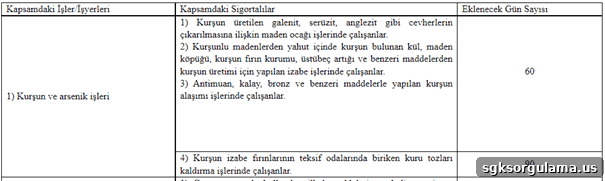
For example, the wear-and-tear allowance for lead and arsenic work is 60 days. However, work that involves handling dry powder is credited with 90 days.
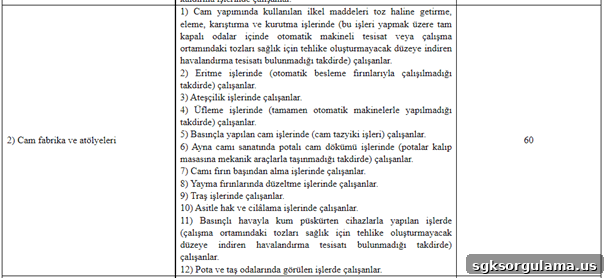
Glass factory and workshop workers receive a 60-day allowance. This includes processes such as melting, firing, and blowing in various glass-working stages.
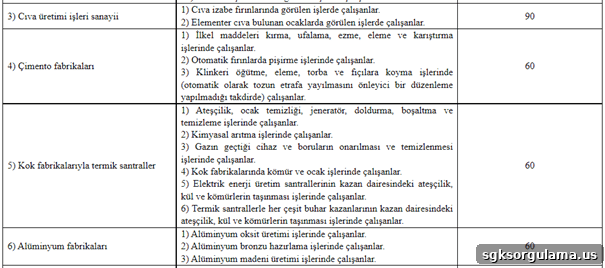
Mercury production, cement, coke, aluminum factories and thermal power plants are also covered. Mercury production receives a 90-day allowance while many other industries receive 60 days.
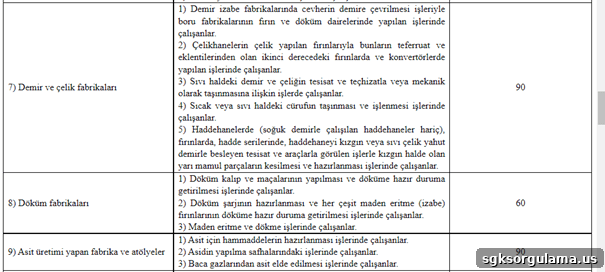
Foundry work is allocated a 60-day allowance; acid production facilities and iron-steel factories are allocated 90 days.
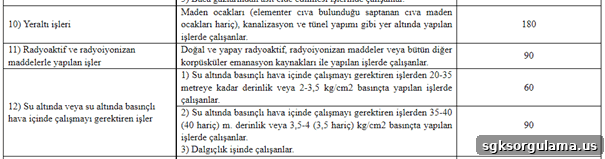
As shown in the table, the largest allowance applies to underground work. Tasks involving radioactive or radioionizing materials and certain underwater operations receive 90 days, while some underwater tasks are credited with 60 days.
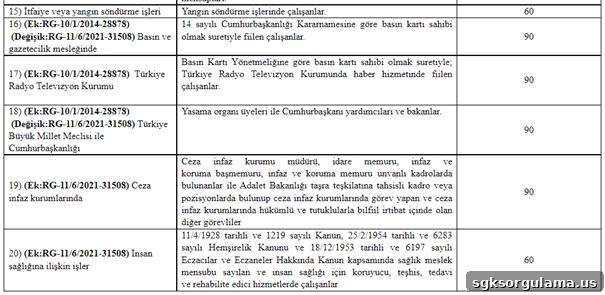
Following amendments in 2014 and 2021, the wear-and-tear allowance was extended to several additional professions, including:
- Holders of press cards
- Members of the legislative body, deputy presidents, and ministers
- Correctional institution staff
- Healthcare professionals
How Is the Additional Service Time Allowance Calculated?
Calculation of the allowance uses a straightforward formula that estimates the effective service time credit. For jobs that add 60 days per year, multiply the number of days worked by 0.17. For jobs that add 90 days, multiply by 0.25. For jobs that add 180 days, multiply by 0.50.
For example, an employee with 7,000 days of service in a 60-day category would have their allowance calculated as 7,000 × 0.17 = 1,190 days. This amount is added to the total service period and can be deducted from the retirement age.
Does the Allowance Affect Pension Amount?
Yes. The allowance increases the number of contribution days, which can raise the calculated pension amount. Consequently, beneficiaries may receive a higher pension.
What Are the Benefits of the Additional Service Time Allowance?
The benefits are significant. Heavy and hazardous jobs carry risks that increase the likelihood of certain illnesses and cause psychological strain. By enabling earlier retirement, the allowance helps workers leave the labor market before suffering excessive wear-and-tear.
Continuing heavy and dangerous work at advanced ages is especially difficult. While some lower-risk occupations allow continued work later in life, demanding jobs become much harder to sustain. For these reasons, the allowance is considered an important protective benefit.
Do You Need to Apply to Receive the Allowance?
No application is required. The allowance is added automatically to the insured person’s record, and contribution days are calculated through the system. No additional steps or separate applications are generally necessary.
Other Ways to Retire Early
Besides the allowance, other options can enable earlier retirement, such as periods that can be purchased (borçlanma). Time spent for education, maternity leave, and military service can often be bought back to increase contribution days and accelerate retirement eligibility.
Maternity-related buyback is available for up to three children. Military service time, internships of lawyers and doctors, and periods of doctoral studies can also be purchased. Additionally, disabled individuals and those who permanently lose their capacity to work in their trade can retire earlier. Women with disabled children may also qualify for earlier retirement.
What Should Those Who Believe They Qualify Do?
If you believe you qualify but have not been credited with the allowance, you may file a lawsuit. Disputes sometimes arise because the distinction for heavy and hazardous occupations can be ambiguous, creating uncertainty about whether a specific job falls under the category. Workers often bring such cases to labor courts.
If you have doubts about your entitlement, consult an experienced attorney and consider legal action. Many workers also seek retroactive inclusion of previously worked periods once they become eligible. Such retroactive claims are commonly pursued through the courts.