
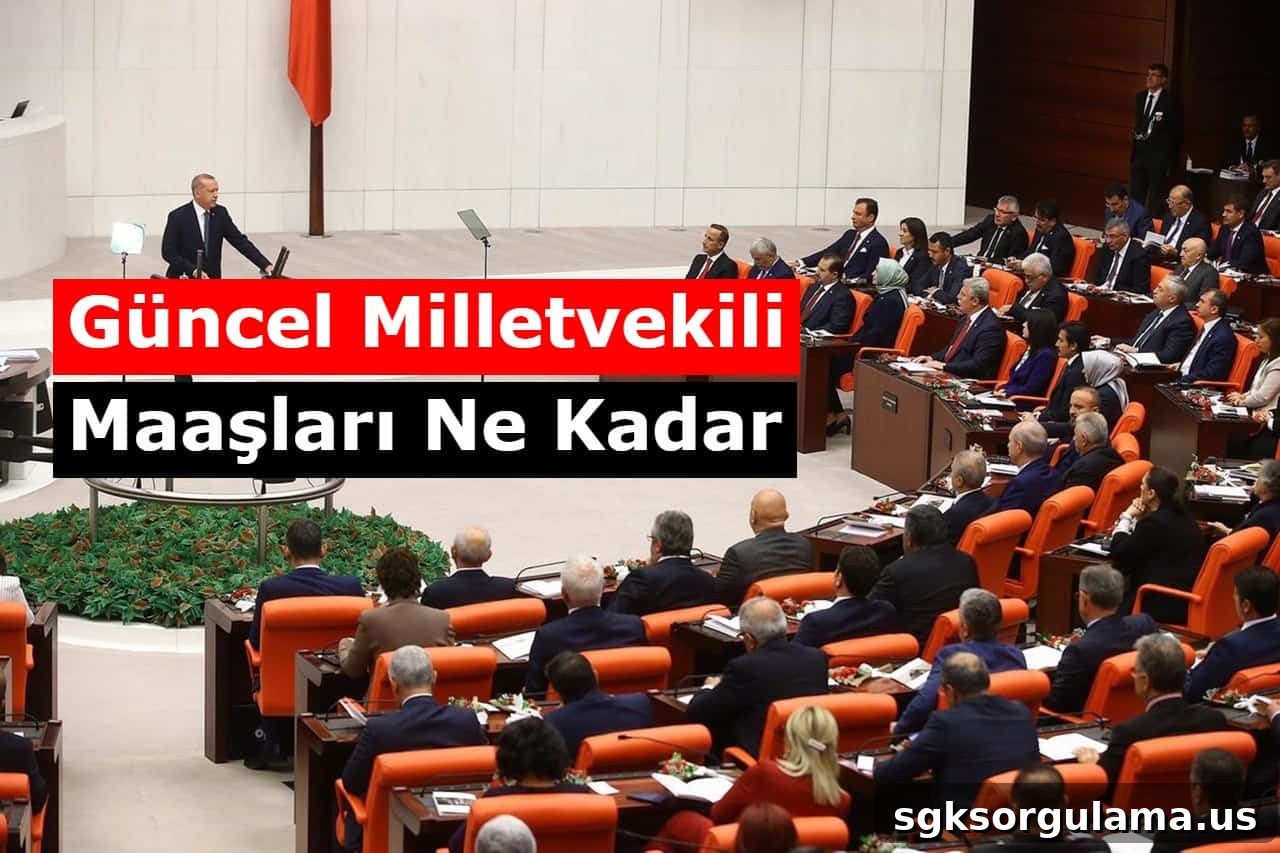
Current parliamentary salaries for 2021 are known as the highest amounts paid to state officials. Members of parliament and ministers receive salaries determined under the Law on Allowances, Travel Expenses and Pensions for Members of the Grand National Assembly of Turkey. High-level state allowances that are not subject to income tax remain exempt under the same legislation. For deputies who began service after 15.10.2008, the 2021 current parliamentary salaries are calculated according to Law No. 5510. According to Law No. 5434, these deputies pay higher retirement deductions, which reduces their net salary.
What Is a Member of Parliament?
A member of parliament serves as a representative of the people in countries governed by democratic principles, acting as a legislator who votes on behalf of citizens. Members of parliament are elected in general elections held every five years and subsequently serve within the parties that win by majority vote. Those who are not affiliated with any party may run as independent candidates during elections. As of the current year, the Grand National Assembly of Turkey is composed of 600 active members.
What Do Members of Parliament Do?
Members of parliament are political figures entrusted with voting on behalf of the public. Their core responsibilities include being the voice of the electorate and making decisions through votes in the assembly.
In addition, the broad scope of duties for members of parliament includes:
- Participating in the enactment or repeal of laws.
- Supervising the Council of Ministers while the assembly is in session.
- Reviewing and deciding on clauses of international agreements and treaties to be signed with foreign countries.
- Conducting parliamentary inquiries and submitting required documents.
- Preparing motions of censure when necessary.
- Closely following national issues and addressing them from the parliamentary podium.
- Engaging in consultations with the prime minister and other ministers.
- Attending extraordinary conventions.
- Listening to public demands and needs, and proposing solutions to problems.
- Deciding on the minting of currency.
- Deciding on declarations of war.
- Approving international agreements and treaties.
- Granting authority to issue decrees with the force of law on certain matters, when applicable.
- Deciding on general or special amnesties by a three-fifths majority of the total membership of the Assembly.
- Performing other duties prescribed by the constitution and laws.
- Preparing or approving budget bills and participating in many other legislative and oversight functions.
What Are the Requirements to Become a Member of Parliament?
Members of parliament do not represent only the region that elected them or the party that nominated them; they are obligated to represent the entire public. Therefore, standing with the people and listening to their problems are among the most important qualifications for MPs. The constitution also sets out specific eligibility criteria.
The constitutional requirements to become a member of parliament include:
- Being a citizen of the Republic of Turkey,
- Being over 18 years of age,
- Having at least primary education,
- Not being subject to any military service impediment,
- Not having been sentenced to one year or more in prison for offenses other than negligent crimes,
- Not having committed smuggling or similar crimes,
- Not being deprived of public rights,
- Not having committed offenses related to revealing state secrets or similar crimes,
- Not having committed crimes aimed at toppling the government or similar offenses,
- Not having been involved in rigging public tenders or similar offenses,
- Not being barred from public service,
- Not having committed fraud or similar crimes.
What Are the 2021 Salaries for Members of Parliament?
As top-level state officials, deputies’ salaries are set by law. Members of parliament receive salaries at the same level as the Chief Undersecretary of the Prime Ministry. In addition, they receive bonuses in January, April, June, July, October and December.
Salaries determined by the Council of Ministers vary by career, and the current parliamentary salaries for 2021 are as follows:
- As of 2019: 22,500 Turkish Lira
- As of 2020: 25,000 Turkish Lira
- As of 2021: 25,000 Turkish Lira (current parliamentary salary)
Application Fees for Parliamentary Candidacy and Preliminary Candidacy
When applying to be a parliamentary candidate or a preliminary candidate within a party, applicants generally pay a registration fee. Fees and conditions vary by party, but typical candidate application fee ranges are:
For male candidates;
- Fees vary by party, commonly between 5,000, 6,000 or 10,000 Turkish Lira.
For female candidates;
- Fees vary by party, commonly between 2,500, 3,000 or 10,000 Turkish Lira.
For candidates aged 25 and under;
- Fees vary by party, commonly between 2,500 or 5,000 Turkish Lira.
For relatives of martyrs or veterans;
- Some parties waive fees for these candidates; where fees apply they typically range from 1,000 to 5,000 Turkish Lira.
For disabled candidates;
- Some parties waive fees if the candidate presents a 40% disability report; where fees apply they generally range from 1,000 to 5,000 Turkish Lira.
For independent candidates;
- The fee is set at 13,000 Turkish Lira.
What Documents Are Required to Run for Parliament?
After meeting eligibility requirements, applicants submit specific documents that may vary by party. Basic documents typically required to become a parliamentary candidate include:
- A signed and completed application form or petition (wet signature required),
- Two copies of the national ID card with the Turkish ID number clearly visible, or the original national identity card,
- Two copies of educational qualification documents, with the original presented at application,
- An archive-registered criminal record certificate,
- Four passport-sized photographs,
- A copy of the resignation or retirement document for those required to resign from public service, along with a receipt of submission if applicable,
- For male candidates, a document indicating completion of military service or an explanation if not completed,
- A bank receipt proving payment of the candidacy application fee; the original receipt should be filed with the application.
What Qualities Should Members of Parliament Have?
In addition to political qualifications, members of parliament are expected to demonstrate social and personal qualities after being elected. General qualities of an MP include:
- Being selfless and dedicated,
- Demonstrating leadership and the ability to lead,
- Serving as role models for society,
- Being well-informed about national issues,
- Approaching events with both public conscience and political ethics,
- Avoiding unrealistic promises that would undermine public trust before election,
- Expressing views respectfully,
- Maintaining consistency between lifestyle, behavior and statements,
- Acting in the best interest of those they represent throughout their term,
- Being at least locally or nationally specialized in an area that helps solve public problems,
- Being transparent with constituents about activities and decisions,
- Striving for impartiality while performing duties,
- Adhering to democratic rules and principles,
- Treating all citizens equally as their constituents,
- Acting in a manner that supports the integrity of the state,
- Providing periodic public disclosure of assets and using communication channels to inform citizens at the end of legislative terms.
How Are Parliamentary Salaries Determined?
Parliamentary salaries and ministerial salaries are determined under the Law on Allowances, Travel Expenses and Pensions for Members of the Grand National Assembly. In addition, salaries of the president, ministers and deputies are set within the scope of Laws No. 5434 and 5510. These amounts also affect retirement pension calculations.
How Do Members of Parliament Retire?
For parliamentary retirement, deputies may use periods of service and borrowing options after serving actively for at least two years. Deputies who complete 5,600 premium days and meet age requirements can retire. A deputy’s retirement pension is set at 45% of the president’s retirement pension.
What Rights Do Members of Parliament Have?
Former deputies are entitled to the same personal and social rights granted to current assembly members, even if their own service rights have ended. Rights enjoyed by members of parliament include:
- Parliamentary immunity for legislative acts,
- Maternity leave for female members,
- Traffic priority under road traffic legislation,
- Special identity cards,
- Funerals organized according to protocol if wished,
- Provision of a special badge,
- Right to carry firearms in specified circumstances,
- Priority on protocol lists,
- Privileges at social facilities,
- Access to regular health screenings and additional benefits.
How Much Do Retired Members of Parliament Receive?
Retired deputies’ current pensions, as determined in budget proposals submitted to the Assembly, are as follows (excluding additional payments):
- As of 2019: 13,410 Turkish Lira
- As of 2020: 15,800 Turkish Lira
- As of 2021: 15,800 Turkish Lira (current pension for retired members)