
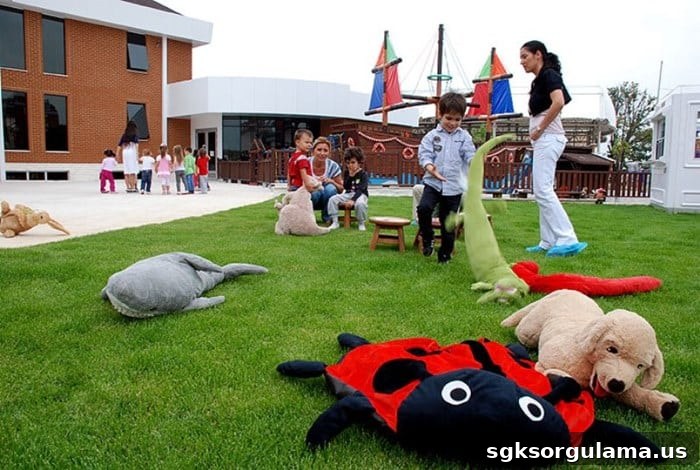
What Are the New Measures for Private Daycares, Children’s Clubs and Day Care Centers? Facilities that were closed due to the coronavirus restrictions have begun to reopen and resume activities as part of the normalization plan. Among these are private daycares, children’s clubs and day care centers. The measures to be applied when these facilities, authorized to open by the Ministry of Family, Labor and Social Services, resume operations after June 1 are outlined below.
According to the announcement, private daycares, children’s clubs and day care centers will resume operations as of June 1, 2020. A guide prepared by the General Directorate of Child Services detailing the rules and measures to be followed in facilities authorized to open has been sent to provincial authorities. The guidelines include detailed precautions for institutions, parents, children and transport services. The details sent to provinces are summarized below.
Groups Will Consist of No More Than 10 Children
Group sizes will be reduced so that no more than 10 children are assigned to a single group in private daycares, children’s clubs and day care centers. Shared spaces will host no more than 10 children at a time. Children will use the dining area with their own groups, and if seated at the same table they must be spaced 1.5 meters apart. During nap times, beds will be arranged with at least 1.5 meters between them.
Same Children Will Stay Together in the Same Areas
Within facilities authorized and inspected by the Ministry, each group will remain together and use the same areas. Movement of children between groups will not be allowed, and staff assigned to a group must avoid contact with other groups. Social distancing rules will be observed throughout the facility, between staff and children and in all service areas.
Cleaning at Least Twice Daily and Ventilation at Least Every 40 Minutes
Hygiene stations will be installed at heights out of children’s reach in common areas. Hand sanitizers will be placed at designated points, and frequently touched surfaces, shared spaces and restrooms will be cleaned at least twice a day. Kitchen tools and utensils will be washed with water and detergent after each use. All disinfectants and cleaning supplies will be recorded. Visual materials that promote new hygiene and handwashing habits will be used. Groups will take turns going to the outdoor area, while their rooms are cleaned and ventilated during those rotations.
No Exchange of Toys or Books
Items brought from home, such as toys and books, will not be accepted. Activities involving the exchange of toys, books or similar items will be suspended. Except when strictly necessary, parents and visitors will not be allowed into the facility. Enrollment procedures will be completed when children are not present. Parent meetings and events involving outsiders, whether inside or outside the facility, will be suspended. Markings will be placed at facility entrances to help parents maintain social distance during drop-off and pick-up. Isolation rooms will be prepared for suspected cases.
Separate Clothing Systems for Staff Inside and Outside the Facility
Staff showing symptoms or with a history of contact will not be allowed to work. The facility manager will brief staff on coronavirus precautions, and this training will be documented. Staff will have their temperature measured with a contactless thermometer upon arrival. All staff will wear masks, which will be changed regularly, and food service and cleaning personnel will use gloves. Staff will wear different clothing inside the facility than they use outside, and employees are expected to remain on-site during working hours.
No Sharing of Personal Belongings
Children with flu symptoms or other illnesses will not be admitted. Children with chronic conditions will be identified so appropriate precautions can be taken. Children should have separate indoor and outdoor clothes and shoes, and hands must be washed with soap and water. Children’s temperatures will be measured hourly on arrival and departure and recorded; children with elevated temperatures will not be admitted.
Children will not share personal belongings; each child’s items will be kept separate. Social distancing will be taught to children in an age-appropriate way. Handwashing for 20 seconds will be demonstrated for their age group, and routine handwashing and coughing/sneezing into the elbow will be taught. Information about illnesses, transmission routes and precautions will be conveyed through play and age-appropriate activities.
Children Showing Symptoms Must Not Be Brought to the Facility
Children who are sick or have a fever in the family should not be brought to the facility. Families must inform the facility if coronavirus is detected in the household or close contacts. Children’s daily temperature checks will be recorded. If a child shows symptoms at the facility, the family must take the child to healthcare services and notify the facility of the child’s health status.
Transport Capacity and Social Distancing Will Be Planned for Service Vehicles
Parents who use transport services should confirm that the required precautions are being applied. Staff showing symptoms or with contact history will not be assigned to transport duties. Vehicles and frequently touched areas will be cleaned before and after each trip. Contact between children inside the vehicle will be minimized where possible. Vehicle capacity will be planned with social distancing in mind, and hand sanitizer will be available at vehicle entrances. Drivers and accompanying staff must wear masks during travel.