
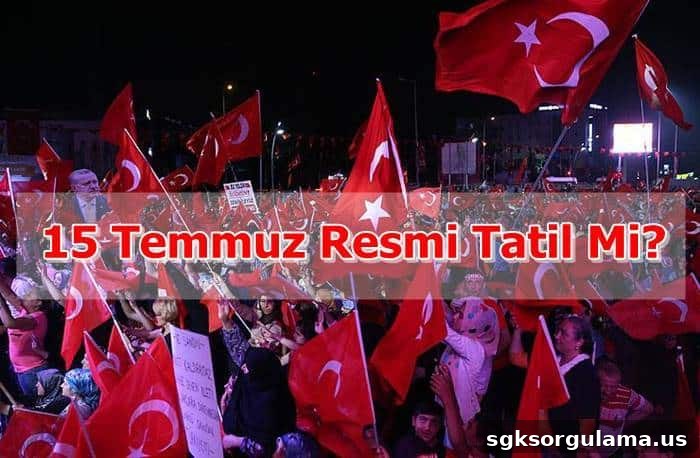
Is July 15 a Public Holiday?
On July 15, 2016, a military coup attempt targeted our democracy and political order. It was prevented thanks to the determined stance of our people who defended democracy. We remember with gratitude the martyrs and veterans who sacrificed themselves for the country. Following the incident, a law accepted on October 25, 2016 and published in the Official Gazette on October 29, 2016 recognized July 15 as a public holiday, placing it alongside previously established holidays such as May 1 and January 1. This year, for the first time that July 15 is observed as a holiday, we will explain the rights and obligations of employees and employers on that date.
Can Employers Require Employees to Work on July 15?
First it should be noted that July 15 is considered a general public holiday. Under Turkish labor law, to have an employee work on a general holiday the employment contract or a collective bargaining agreement must include the employee’s consent to work on such days. If the contract does not contain such a provision, the employer must obtain the employee’s approval before having them work on a general holiday.
Can an Employee Be Fired for Not Going to Work on July 15?
As stated above, if the employment contract or a subsequently signed consent agreement obliges the employee to work on general holidays, the employee must go to work when requested by the employer. Otherwise, according to Article 25 of Law No. 4857, an employer may have the right to terminate the employment contract in cases where the employee refuses to attend work without the employer’s permission or without a justified reason: “the employee’s unjustified absence from work for two consecutive workdays, or failure to attend work on the business day following any holiday on two occasions within a month, or absence from work for three workdays within a month.” In such circumstances, the employer could lawfully terminate the employment relationship.
However, if your contract contains no clause regarding work on general holidays, you may inform your employer that you do not wish to work on those days and refrain from going to work. In that case you should not face adverse consequences related to termination. Indeed, if an employer forces an employee to work on a general holiday without contractual consent, the employee may have the right to terminate the employment with just cause.
How Is Pay Calculated for Work on General Holidays?
According to Article 47 of Law No. 4857, “if employees do not work on days recognized as general holidays, they are paid their full daily wage without performing work; if they do work instead of taking the holiday, they are paid an additional one day’s wage for each day worked.” Therefore, work performed on July 15—being a general holiday—must be compensated at double the employee’s daily wage: the regular pay for the day plus an additional day’s wage for working the holiday.
In Closing
We remember all our martyrs and veterans with gratitude. We extend our condolences to the families of the martyrs and wish a speedy recovery to our veterans.