
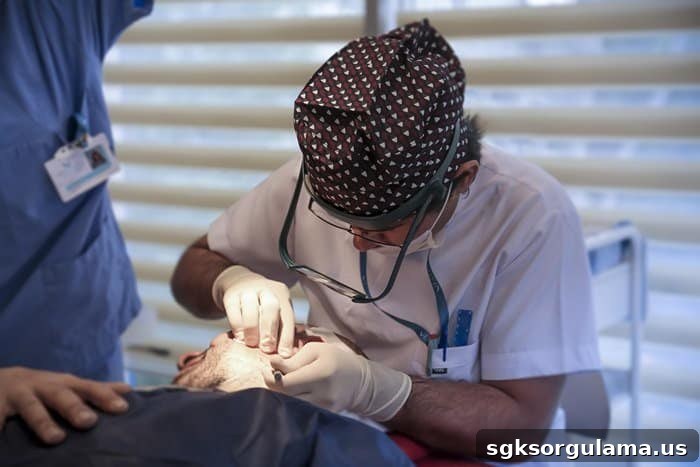
According to standard regulations, cosmetic procedures such as hair transplantation are not covered by most insurance policies. Recent changes in Turkish social security law, however, have altered this situation somewhat. With the new regulations, aesthetic plastic surgery centers can now enter into agreements with the Social Security Institution (SGK), the Pension Fund (Emekli Sandığı), and Bağkur.
Outside of SGK, Emekli Sandığı and Bağkur, no private insurance currently covers aesthetic surgical procedures.
That said, some private health insurers and private aesthetic centers can provide plastic surgery under the terms of their agreements, with patients paying a co-payment or pricing difference. The amount of that difference varies between clinics. People with private health insurance may be able to undergo procedures with a relatively small additional cost and in experienced hands. Private aesthetic centers generally employ professional, board-certified plastic surgeons and offer services at international standards. These centers have built reputations by applying latest technologies and proven techniques over many years, which often makes them preferred choices. By contrast, aesthetic programs newly introduced in public hospitals may still be developing their track record.
Is Hair Transplantation Performed in Public Hospitals?
Hair transplantation plays an important role in preventing psychological distress and helping people feel secure in social environments, and it has become a commonly performed cosmetic surgery today.
Achieving the best results in hair transplantation, as with any cosmetic surgery, requires experienced professionals and modern equipment. Private aesthetic centers have demonstrated consistent success in this field and, with their experienced teams, have delivered high-quality outcomes for many years.
Public hospitals have more recently started offering hair transplantation. Although some public hospitals began performing these procedures around 2015, the outcomes and success rates in those settings are still discussed. Appointment processes can be lengthy and involve several steps. Additionally, hair transplantation in public hospitals is currently available in only a limited number of institutions, so it is not offered to everyone who requests it.
What Is Hair Transplantation?
Many people want healthy, thick hair. However, hair thinning and baldness can occur for many reasons: genetic factors, hormonal disorders, medical conditions, aging, burns, and others. In these cases, hair transplantation performed by professional plastic surgeons can be an effective solution. Modern hair implantation techniques practiced in private plastic surgery centers have advanced significantly. Transplanted hair looks natural and, once established, does not fall out in the same way as the previous hair.
How Is Hair Transplantation Performed?
Hair transplantation involves taking hair follicles from certain donor areas of the body—commonly the back of the scalp, and sometimes the chest, arms or legs when appropriate—and moving those follicles to balding areas on the scalp. Techniques for hair transplantation date back to the 19th century and evolved significantly during the 20th century, increasing both popularity and success rates. With ongoing technological improvements, modern hair transplant procedures yield positive results.
Today, hair transplantation is a widely chosen procedure and has become more accessible and easier to perform thanks to advanced techniques.
What Are the Hair Transplantation Methods?
FUT Technique (Follicular Unit Transplantation):
In the FUT method, a strip of scalp containing hair follicles is removed from the donor area—typically the back of the head—and the follicles are dissected and transplanted into channels opened in the recipient area. This technique has become less popular due to drawbacks: the donor strip can leave a visible scar at the back of the head and may cause temporary numbness. FUT is still applied in selected cases where a sufficient number of grafts are required and the patient’s condition is suitable, but it has largely been superseded by newer techniques. FUT is performed under local anesthesia; if the donor area has limited hair, a wider strip may be required to obtain enough grafts. After grafts are prepared, the donor site is sutured, which can leave a scar. Because of this, many plastic surgeons prefer alternative methods such as FUE.
FUE Technique (Follicular Unit Extraction):
FUE is the most commonly used hair transplant technique today. Performed under local anesthesia and without extensive surgical incisions, FUE has encouraged many patients who were previously hesitant. The procedure uses specialized micro-motor instruments to extract hair follicles individually from donor areas and implant them into bald zones while respecting the natural angle and direction of hair growth. Extracted follicles are trimmed to approximately 1 mm lengths. A micro-punch tool centers the hair shaft, creates a tiny cylindrical incision in the scalp tissue, and the follicle is gently extracted. This approach minimizes graft trauma, increases graft yield, and shortens operation time. The collected grafts are then implanted into the small recipient sites created on the scalp.