
Being insured is an important concept in our country. For those who cannot find employment in the public or private sector, the government created Bağ-Kur coverage for self-employed and small-scale workers. There is also a specific agricultural Bağ-Kur branch for people engaged in farming activities. As with other retirement systems, agricultural Bağ-Kur members must meet specific conditions to retire. Agricultural Bağ-Kur members can retire with fifteen years of contributions, a form of early retirement often referred to as partial retirement.
The state provides a number of advantages to those working in agriculture, and one of these is the right to register under agricultural Bağ-Kur. To register, an individual must first be registered with the Chamber of Agriculture or the provincial/district Directorate of Agriculture. A person who applies for agricultural Bağ-Kur must not have other employment: they cannot be receiving a salary or pension from another job. If they are currently paid by another employer, they are not eligible to apply for agricultural Bağ-Kur. If the applicant is under 18, agricultural Bağ-Kur coverage begins once the person turns 18. Applicants older than 65 cannot be enrolled in agricultural Bağ-Kur.
The circumstances that terminate agricultural Bağ-Kur differ from other insurance schemes. If a person engaged in agriculture stops farming, their agricultural Bağ-Kur coverage ends. Similarly, if an agricultural Bağ-Kur member becomes employed and insured under another social security institution, their agricultural Bağ-Kur status terminates as of the beginning of that month.
Agricultural Bağ-Kur members may qualify for partial or early retirement under certain conditions. The partial retirement rules based on fifteen years of contributions differ for men and women.
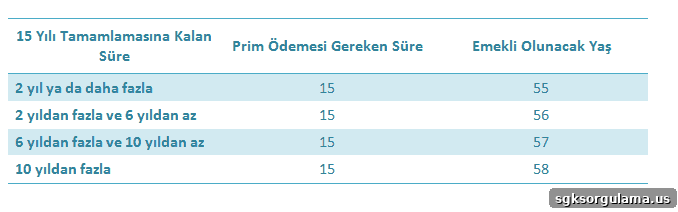
According to the law, for male agricultural Bağ-Kur members the retirement age depends on how many years remain until they complete fifteen years of contributions. If two years or less remain for completing the fifteen-year contribution requirement, the retirement age is 55. If more than two years but less than six years remain, and the member completes these contributions, the retirement age is 56. If the remaining period is more than six years but less than ten years, the retirement age is 57. If more than ten years remain and the member completes the required contributions, the retirement age becomes 58.
The age rules for women under the agricultural Bağ-Kur partial retirement after fifteen years differ from those for men.
The following conditions apply for women who wish to retire after fifteen years of contributions. If two years or less remain until the completion of the fifteen-year contribution period, and the contributions are paid up, the woman can retire at 50. If more than two years but less than four years remain, upon completing contributions she can retire at 51. If more than four but less than six years remain, the retirement age is 52. If more than six but less than eight years remain, she can retire at 53 once contributions are completed. If more than eight but less than ten years remain, the retirement age is 54. If more than ten years remain, the retirement age for a female agricultural Bağ-Kur member rises to 56 when she completes the required contributions.
In addition to partial retirement, agricultural Bağ-Kur includes a standard retirement option. The standard retirement requirements for agricultural Bağ-Kur are the same as those for the artisan and tradesman Bağ-Kur category. While partial retirement allows retirement with fifteen years of contributions, the standard retirement under agricultural Bağ-Kur typically requires a contribution period of twenty-five years. Once a member completes twenty-five years of recorded contributions, they become eligible for regular retirement benefits under agricultural Bağ-Kur.
In summary, agricultural Bağ-Kur provides flexible retirement options tailored to farmers and agricultural workers. Eligibility depends on registration with the relevant agricultural authorities, the absence of other insured employment, and meeting required contribution periods. Partial retirement after fifteen years offers earlier retirement ages that vary by gender and by how much of the contribution period remains, while the standard retirement route follows the longer contribution requirement of twenty-five years.