
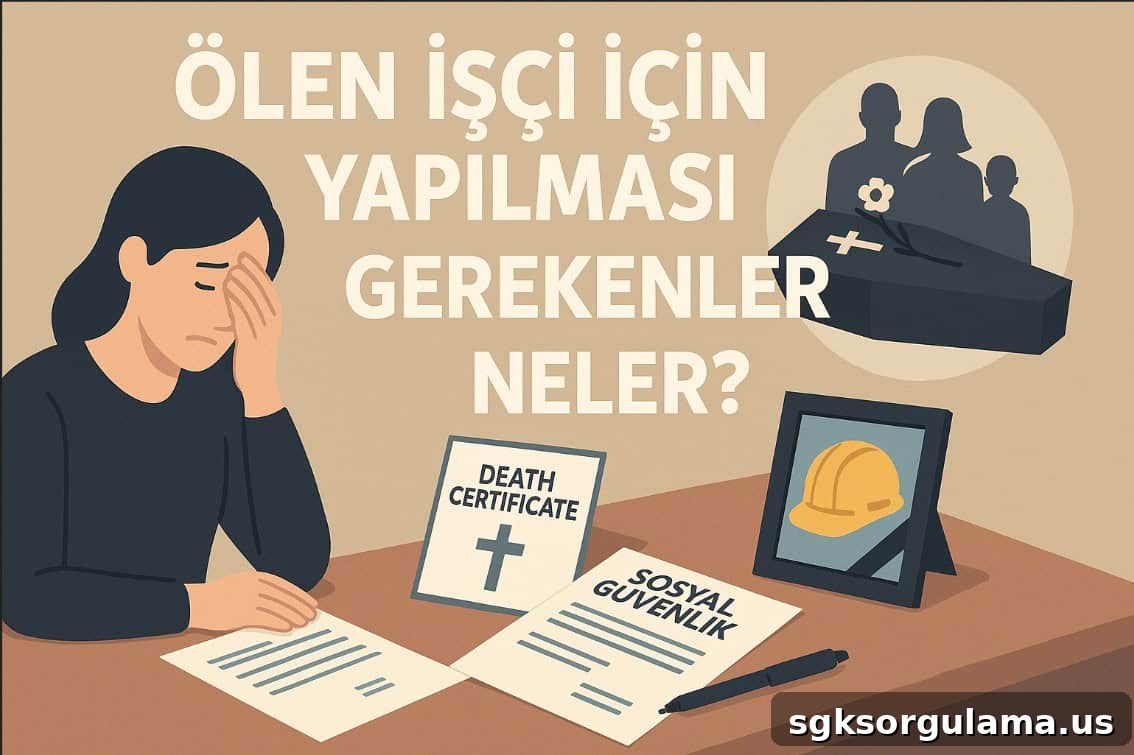
What to do when a worker dies is a serious process covering the legal responsibilities of the employer and the deceased’s relatives. After a death, not only humanitarian but also legal and administrative steps must be taken. Completing these steps accurately and on time prevents loss of rights and helps the process proceed properly.
Procedures following a worker’s death include SGK notifications, severance pay, survivor’s pension, funeral allowance, and, if applicable, work accident reports. There are important points employers and family members must observe during the process. Below we explain all steps to follow after a worker’s death in detail.
What legal notifications must the employer make?
The employer must first notify the Social Security Institution (SGK) about the deceased worker. The notification method can vary depending on the cause of death.
Actions to take with SGK:
- Employment termination notification: submit via e-SGK selecting “Code 12 – Termination due to death.”
- Work accident report: if death resulted from a workplace accident, report to SGK and the public prosecutor within 3 business days.
- Attach the medical report or death certificate to the file.
- Inform law enforcement if necessary.
Late or missing notifications can result in administrative fines. These obligations are evaluated under Law No. 5510 and the Occupational Health and Safety Law No. 6331.
What rights do family members have?
The deceased worker’s beneficiaries — spouse, children, and, under certain conditions, parents — have specific rights under SGK and Labor Law. These rights exist to provide financial support and to secure the deceased’s entitlements.
Benefits family members may claim:
- Survivor’s pension (widow/widower and orphan pension)
- Funeral allowance
- Severance pay
- Accrued wages, unused annual leave and other entitlements
- Compensation for work accident-related damages
- Lump-sum payments or premium refunds in certain cases
To claim these rights, submit the required application documents, the death certificate, and identification to SGK. Complete notifications from the employer also help speed the process.
Survivor’s Pension (Widow/Widower and Orphan Pension)
The survivor’s pension is a regular payment provided to the deceased worker’s eligible dependents. It is regulated under the Social Insurances and General Health Insurance Law No. 5510 and is calculated based on the deceased’s insured days.
Conditions to apply for the survivor’s pension:
- The worker must have paid at least 1,800 days of insurance premiums for disability, old-age, and death insurance.
- If death resulted from a work accident, the premium day requirement is waived.
- Applications are made to SGK provincial or district directorates.
- The spouse, children under 18, and parents legally dependent on the deceased may receive the pension.
Required documents:
- Death certificate
- Identity registry extract
- Certificate of heirs (probate document)
- Application form
The pension amount varies according to the number of beneficiaries. For example, if only the spouse is eligible, they may receive 75% of the calculated pension; if children are also eligible, the amount is divided among them.
How to receive the funeral allowance?
The funeral allowance is a one-time payment by SGK to the deceased insured person’s relatives to help cover funeral expenses.
To be eligible for the funeral allowance:
- At the time of death the person must have been registered with SGK and have no outstanding premium debt.
- Premiums should have been paid as an active insured or as a retiree.
- Apply at the nearest SGK office.
An application letter and the death certificate are usually sufficient. Payments are typically processed within one to two weeks.
Severance Pay and Notice Pay Process
One of the most asked questions regarding what to do when a worker dies is how severance pay is handled. A worker’s death is among the events that entitle beneficiaries to severance pay.
Points to consider about severance pay:
- The worker must have worked at the same workplace for at least one year.
- Because the employment relationship ended due to death, severance is paid directly to the heirs.
- Payment is made to the eligible beneficiaries or legal heirs.
- Severance is calculated based on the worker’s gross salary multiplied by the number of years worked.
- Payment is made to the person(s) who present the probate document.
Notice pay:
Normally notice pay is due when an employer fails to give notice before termination. However, since the worker did not leave voluntarily in the event of death, notice pay generally does not apply. In most cases notice pay is not paid, though contract-specific exceptions may exist.
Additional rights if a work accident occurred
If the worker’s death resulted from a work accident, the process differs for the employer and the beneficiaries. Workplace accidents must be reported not only to SGK but also to judicial authorities.
Actions required in the event of a work accident:
- The employer must report the accident to SGK and the public prosecutor within 3 business days.
- Include an incident report, witness statements, and, if available, camera footage in the file.
- The criminal investigation will examine whether the employer was at fault.
- SGK may grant income benefits to the deceased worker’s beneficiaries.
Additional payments available to beneficiaries:
- Permanent incapacity income (paid to survivors in case of death)
- Work accident compensation (a separate lawsuit may be filed if the employer is at fault)
- Material and moral damages (by court decision)
In cases of work accidents, it is essential to involve a labor law attorney, since potential compensation for beneficiaries is often much greater than in ordinary death cases.
SGK notification process and required documents
One of the most critical steps among the things to do when a worker dies is to make timely and complete notifications to SGK. Employers and family members have distinct responsibilities.
Employer responsibilities:
- Submit employment termination notice due to death (Code 12)
- If the death was a work accident, report the accident to SGK
- Provide workplace records and incident reports if available
- Provide necessary information to judicial authorities
Applications to be made by the family:
1- Apply to SGK for survivor’s pension and funeral allowance
2- Required documents:
- Death certificate
- Identity registry extract
- Certificate of heirs (probate document)
- Application letter
Submitting complete documents ensures that procedures are completed without delay. Incomplete applications will not be processed.
Distribution of inheritance and outstanding employee claims
All unpaid rights the deceased worker earned during employment belong to the legal heirs. These entitlements include the worker’s final salary, unused annual leave pay, and any overtime pay.
Who receives these claims and how are they paid?
- Beneficiaries apply to the employer with the probate document.
- The employer must distribute payments among the legal heirs.
- If payment is to be made to a single heir, obtain a consent statement from the others.
- If heirs cannot agree, the employer may pay according to a court decision.
Items owed to heirs:
- Severance pay
- Payment for unused vacation
- Overtime pay
- Other accrued entitlements
The statute of limitations for claiming these entitlements is five years. If no claim is made within this period, the right may be lost.