
The pension amount a person receives after retiring under the EYT regulation depends on their earnings while working and the number of premium payment days. With the EYT arrangement, more than two million people have gained the right to retire.
In public discourse, those affected by EYT—commonly called “those who are stuck by retirement age”—typically meet the premium payment requirements but cannot retire because they do not meet the age criterion. Legislative changes made before a certain date prevented many people from becoming eligible for retirement.
The pension amount someone will receive from EYT is a frequent question among beneficiaries. Some people may not qualify for full retirement and instead will be eligible for partial retirement, which generally results in a lower pension.
The EYT regulation is expected to have a legal framework established in 2023. Once the legislative proposal is submitted to parliament and voted on, many people are expected to be able to exercise their retirement rights.
Who Can Retire Under EYT?
To retire under EYT, applicants must meet specific dates and premium payment day requirements. The regulation eliminates an age requirement. The main conditions are:
- The insurance start date must be before 8 September 1999.
- Those who meet the date and premium payment conditions can receive a retirement pension without an age requirement.
- Women must satisfy a 5,000-day premium payment requirement and have 20 years of insured service.
- Men must meet a 25-year insured service requirement and the 5,000-day premium payment condition.
- If premium days are missing, individuals may use debt-based contribution options (borçlanma).
People who meet these conditions can claim retirement. The absence of an age requirement in the EYT regulation is a significant advantage. Those who started working before 1999 already meet the insured service length requirement and can apply for EYT if they also meet the premium payment condition.
Who Is Covered by EYT?
EYT covers those who began employment before 8 September 1999. A legal change on that date raised retirement ages and tightened the conditions for receiving old-age pensions, effectively removing rights previously granted by earlier laws.
EYT eligibility conditions differ for 4A, 4B and 4C insured groups. For 4B (BAĞ-KUR) the required premium days vary: 7,200 days for women and 9,000 days for men. Similar rules apply for Emekli Sandığı (retirement fund) beneficiaries under 4C.
There are plans to support employers with severance pay obligations for those retiring under EYT. No finalized arrangement exists yet for people who wish to continue working after retirement, though such measures are being considered. The estimated number of people who could benefit from EYT is around 2,250,000.
How Is the EYT Pension Calculated?
Calculating an EYT pension depends on factors such as the number of premium payment days and the salary earned while working. You can perform an estimated calculation through the Social Security Institution (SGK) website, but results there are indicative, not final.
For 4A pension estimates, use the SGK monthly calculation page. By entering requested personal and service details, you can obtain an approximate monthly pension amount.
On that page you will be asked for information such as:
- T.C. identification number
- SSK registration number
- Father’s name
- Province of registration
- Date of birth
The screen shown above allows 4B pension queries; a minimum of 5,400 premium days is required to perform a query for some 4B cases. Any calculated monthly amount is only an estimate—the formal pension is determined after you submit applications and your records are verified by the institution.
For 4C pension calculations, use the SGK 4C service calculation page. The pension amount for someone retiring under EYT from Emekli Sandığı can be estimated through that interface.
That page allows entry of service periods across different statuses so you can include all relevant work history in the estimate.
EYT Pension Inquiry
After filing applications, you can check your expected pension amount with an EYT pension inquiry. Before this, the EYT regulation must be approved by parliament and you must complete the required applications.
You can check pension amounts via the e-Government portal (E-Devlet). First, sign in with your credentials at turkiye.gov.tr, then search for “Emekli Maaşı” (Retirement Pension).
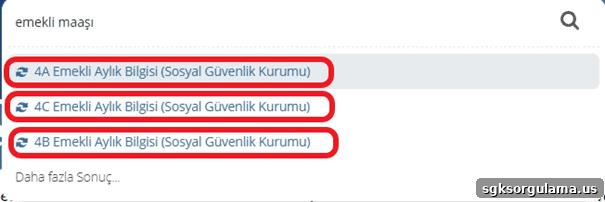
Select the option that matches your status to see the pension amount assigned. If you have not yet applied, search for “Emeklilik Başvuru” (Retirement Application) to begin the process.
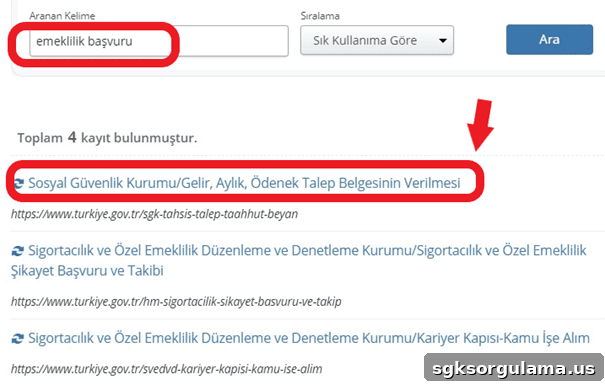
You can submit your application under the “Income, Monthly Allowance, Benefit Claim Document Submission” section. Use the “New Application” option to create your claim.
Who Will Be Able to Retire Under EYT?
The eligibility criteria for retiring under EYT are clearly defined. If the EYT regulation is accepted, many people who meet the conditions will be able to retire and leave the workforce. Different premium day requirements apply to 4A, 4B and 4C insured groups.
4A insured persons generally need fewer premium days compared with others. 4B and 4C insureds usually require a higher number of premium days. The main conditions include:
- Applicants must have started work before 8 September 1999.
- The required premium days for women are 5,000, with an insured service duration of 20 years.
- Men can retire with 25 years of insured service and 5,000 premium days.
- BAĞ-KUR women can retire with 7,200 days; BAĞ-KUR men with 9,000 days.
To reach the required thresholds, applicants may use debt-based contribution options for military service and childbirth. Conditions for these debt-based contributions include:
- Military service must have been completed as a private or non-commissioned member.
- No premiums must have been paid on behalf of the insured person during the military service period.
- Childbirth-related debt-based contribution is valid only if the birth occurred after the insured started working.
- Childbirth debt can be claimed for up to two years per birth.
- Up to 720 days can be claimed per birth.
- Claims are possible for up to three births, making the maximum childbirth debt-based contribution 2,160 days.
- Women who already had premiums paid on their behalf after childbirth cannot claim this debt-based contribution for those periods.
In addition to childbirth and military service, periods such as medical specialty training, doctoral studies and lawyer internship can also be considered for debt-based contributions where applicable.
How Much Will an EYT Beneficiary Receive?
The pension amount for EYT beneficiaries is calculated based on individual details, so amounts will vary from person to person. However, estimates based on lower bound figures can be presented. The lowest expected pensions are shown in the table below.
| Pension Amount | Civil Servant Retiree | Pre-2000 SSK Retiree | Post-2000 SSK Retiree | BAĞ-KUR Tradesperson Retiree | BAĞ-KUR Agricultural Retiree |
| Current | 7.186 TL | 5.491 TL | 3.404 TL | 4.917 TL | 3.907 TL |
| After Increase | 7.500 TL | 7.500 TL | 7.500 TL | 7.500 TL | 7.500 TL |
EYT Calculation Table
An EYT calculation table can be prepared without an age requirement. The crucial factor is the insurance status. Conditions for SSK (4A) differ from those for BAĞ-KUR (4B) and Emekli Sandığı (4C).
The conditions for SSK, BAĞ-KUR and Emekli Sandığı are summarized in the table below.
| Conditions | SSK (4A) | BAĞ-KUR (4B) | Emekli Sandığı (4C) |
| Insurance Start Date | Before 8 September 1999 | Before 8 September 1999 | Before 8 September 1999 |
| Premium Days Required for Women | 5,000 | 7,200 | 7,200 |
| Premium Days Required for Men | 5,000 | 9,000 | 9,000 |
| Insured Service Duration for Women | 20 years | – | – |
| Insured Service Duration for Men | 25 years | – | – |
| Age Requirement | – | – | – |
The pension amount for someone retiring under EYT depends on how many premium days they paid above the minimum thresholds. Additional payments and allowances also affect the final pension amount.