
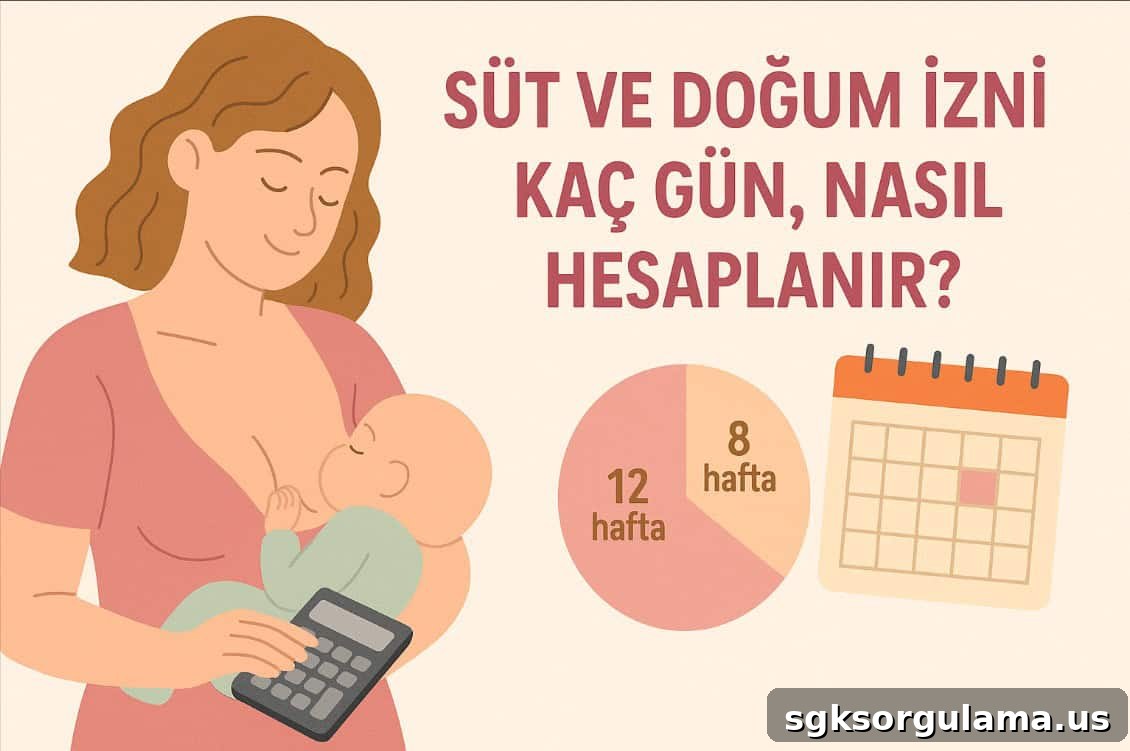
Under maternity and breastfeeding leave provisions, every working mother is entitled to leave for specified periods before and after the birth of her child. The maternity leave duration is generally a total of 16 weeks. If the pregnancy is multiple, this period increases to 18 weeks. This leave period is calculated based on the employment start date reported to SGK by the employer and the date of birth.

Breastfeeding leave is an additional right granted to the mother after birth so she can breastfeed her baby. During this leave, the mother may use a total of three hours per day as a breastfeeding break. Both types of leave are regulated under SGK legislation, specifying how employers must apply them and defining the practical rights of employees.
Maternity Leave Duration According to SGK Regulations
According to SGK, maternity leave provides female employees with 8 weeks before birth and 8 weeks after birth, totaling 16 weeks. This period allows expectant mothers to protect their health before delivery and to care for their newborn afterwards. This duration applies to single pregnancies.
If it is a multiple pregnancy—for example, twins or triplets—an additional 2 weeks is granted on top of the 8 weeks before birth. In that case, the total maternity leave becomes 18 weeks.
The start date of leave is usually determined by a doctor’s report. The process begins with a pregnancy follow-up report issued by an obstetrician after prenatal examinations. If health issues arise during pregnancy or the doctor recommends it, this leave can begin earlier.
Additionally, with a doctor’s approval, the expectant mother may continue working until up to the last 3 weeks of the 8-week pre-birth period. Any unused pre-birth leave in that case is added to the post-birth period, thereby extending the total maternity leave.
Example calculation:
If it is a single pregnancy and the mother worked until the final 3 weeks with medical approval:
- Before birth: 5 weeks
- After birth: 11 weeks
- Total: still 16 weeks
How Many Days Is Breastfeeding Leave and How Is It Used?
Breastfeeding leave is a right granted so a working mother can breastfeed her baby after delivery. Under SGK regulations, this right starts after the maternity leave ends and applies for the first 6 months from the child’s birth at 3 hours per day, and for the following 6 months at 1.5 hours per day. In practice, many employers only apply the first six months.
Breastfeeding leave is used during the mother’s working hours and these hours count as part of her paid working time. Therefore, no salary deduction is made for these break hours. The mother can choose to take them at the start, middle, or end of the workday.
Practical points to note:
- A female employee may combine breastfeeding break hours to leave early or arrive late.
- This right cannot be obstructed by the employer; it is statutory.
- Employing the mother during her breastfeeding break is contrary to labor law.
- During breastfeeding leave, the mother’s insurance premiums and employment rights are preserved.
Sample usage:
- Work hours: 09:00 – 18:00
- The mother might plan her day as 09:00 – 15:00 or 12:00 – 18:00 to accommodate breastfeeding breaks.
How Is Maternity Leave Pay Calculated?
During maternity leave, the state provides a temporary incapacity benefit to employed mothers. This payment is covered by SGK to prevent income loss during leave. The benefit is calculated over a total of 112 days, covering the 8 weeks before birth and 8 weeks after birth.
The amount is determined based on the mother’s average gross earnings for the last 3 months. The daily payment equals two-thirds of the average daily gross earnings. If the mother works at minimum wage, the daily payment is capped accordingly.
Calculation steps:
- Add the gross salaries of the last 3 months.
- Divide by the total number of days to find the average daily gross income.
- Take two-thirds of that daily amount.
- Multiply by 112 days to find the total payment.
Example calculation:
- Total gross salary for the last 3 months: 120,000 TL
- Daily gross: 120,000 / 90 = 1,333 TL
- Daily payment: 1,333 x 2/3 = 888 TL
- Total maternity benefit: 888 x 112 = 99,456 TL
Note: The payment is processed through SGK after birth and deposited into the mother’s IBAN. Funds can be withdrawn from SGK-contracted banks.
What Is the Breastfeeding Allowance (Süt Parası)?
The breastfeeding allowance, commonly known as süt parası, is a one-time cash payment from SGK to mothers who are employed or whose spouses are insured. This payment is given when the mother gives birth and meets certain conditions. For eligibility, the mother or her spouse must have paid at least 120 days of short-term insurance premiums within the year before the birth.
This payment is intended to support care for the child after birth. SGK either deposits the amount directly into the mother’s bank account or it can be collected from partnered PTT branches with identification.
Application process:
- Because the birth notification is usually created automatically in the system, a separate application is often unnecessary.
- It can be checked through the e-Government portal under “breastfeeding allowance inquiry.”
- If the payment does not appear, contact the local SGK office.
About this payment:
- It is a one-time payment.
- It is funded from the SGK budget.
- In the case of twins or triplets, it is paid per child.
- Non-working mothers whose spouses are insured can also benefit.
Is There a Right to Unpaid Leave After Birth?
Female employees who give birth may request unpaid leave after their maternity leave ends. This right is defined under the Labor Law and, upon the employee’s request, the employer must grant it. Unpaid leave provides time for child care and helps the mother transition back to work more flexibly.
The unpaid leave period after birth is up to 6 months. It begins immediately after maternity leave ends and requires a written request to the employer. During unpaid leave, the employee does not receive a salary and SGK contributions are not paid, but the employment contract remains in force.
Characteristics of unpaid leave:
- The employer cannot refuse the leave request.
- The employee does not accrue seniority during this period but cannot be dismissed.
- It is registered as days without SGK contributions.
- To access health services during this time, the employee may use the spouse’s coverage or private insurance.
Example:
- Maternity leave lasted 16 weeks.
- The employee then took 6 months of unpaid leave.
- The total time away from work can reach roughly 9 months.
At the end of this leave period, the employee returns to the same position. The employer is obliged to reinstate the employee at the end of the leave.
Can Maternity and Breastfeeding Leave Be Transferred to the Father?
Maternity leave and breastfeeding leave are individual rights granted only to the mother who gives birth and therefore cannot be transferred to the father. These rights are specifically tied to the mother’s biological condition, postnatal recovery, and breastfeeding needs, so legal transfer to another person is not possible.
However, fathers who are employees do have limited leave rights under paternity leave. Under Labor Law No. 4857, fathers are entitled to:
- In the public sector: 10 days of paternity leave
- In the private sector: typically 5 to 10 days, depending on company policy
Paternity leave starts from the date of the birth. During this time the father is on paid leave and is considered excused from work. Breastfeeding leave applies only to the breastfeeding mother; fathers do not have this right.
In summary:
- Maternity and breastfeeding leave belong exclusively to the mother.
- Paternity leave is limited and cannot substitute or take over maternal leave.
- If the mother takes unpaid leave, these rights do not transfer to the father.