
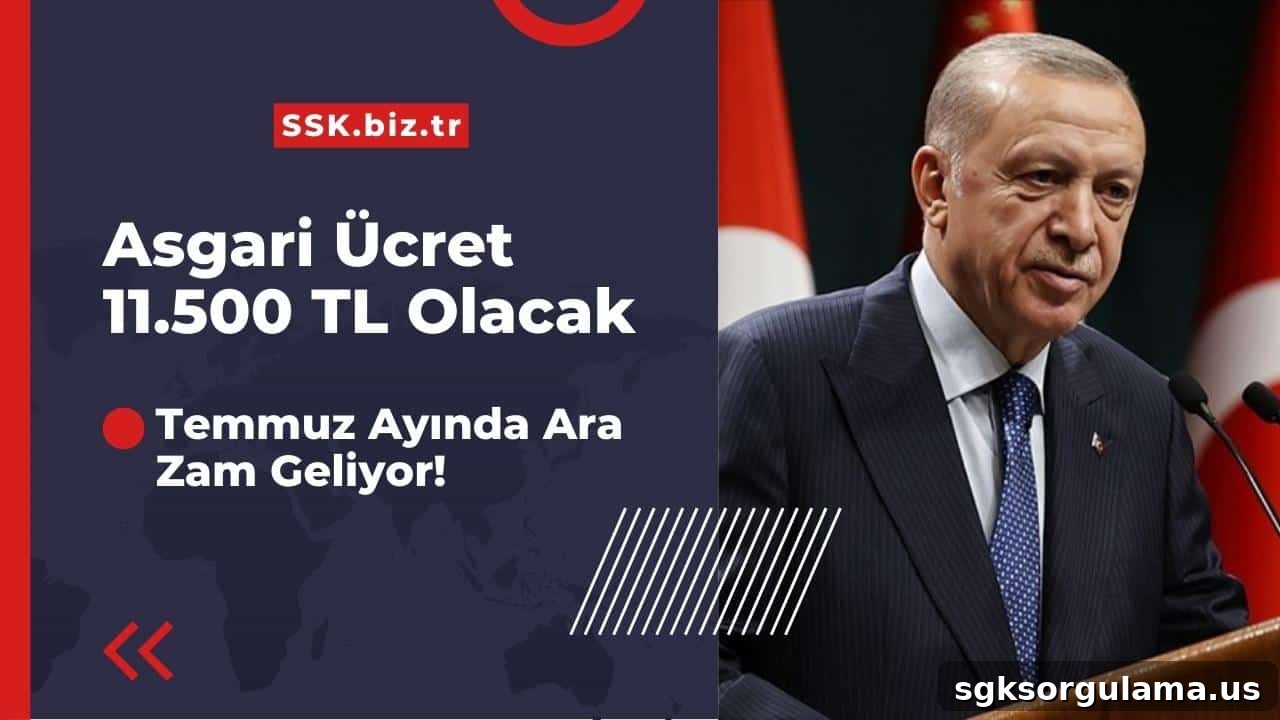
After President Recep Tayyip Erdoğan’s recent remarks that wages could be revised again this year, attention has turned to the minimum wage. Announced as 8,506 TL net at the start of the year, the minimum wage is expected to be reassessed when the commission meets in June and an increase may be implemented. According to a report in Sabah newspaper, further clues about retirement and civil servant raise amounts are emerging. With July approaching, workers and retirees have started to calculate potential salary increases. While public employees await collective bargaining, inflation rates will once again play a decisive role in determining raise levels.
In Turkey, the incomes of millions of citizens are adjusted each year in January and July. The second increase of the year for retirees, workers, public employees, private sector staff and those retiring under the EYT regulation will take place in July. As before, inflation figures will be the primary determinant of the raise amounts. Inflation forecasts and expectations for a “welfare share” provide indications of the likely increase rates. The raises for retirees and public employees and a potential recalibration of the minimum wage also drive private-sector workers’ expectations for pay rises. Below, you can find details on expected minimum wage changes across sectors.
Public Sector Blue-Collar Workers
Collective bargaining negotiations affecting roughly 700,000 public-sector blue-collar workers are reaching a conclusion. New raise rates expected to be announced on May 1 are narrowing as the government side increases its offers. Workers requested a base salary of 15,000 TL while the public side raised its offer to 12,000 TL. Workers also sought a 45% raise for the first six months, while the public side proposed 40%. The negotiations are expected to be finalized this week and announced on May 1.
Minimum Wage Earners
Following President Erdoğan’s statement that the minimum wage might be increased again this year, attention has returned to the earnings floor. The net minimum wage set at 8,506 TL in January is expected to be reconsidered by the commission in June.
As before, inflation figures will be decisive in determining any rise to the minimum wage. Three-month inflation has already exceeded 12%. With April inflation to be announced on May 3, the four-month figure will become clearer. The Minimum Wage Determination Commission is expected to convene in June, set a new minimum wage, and for that change to take effect as a July raise.
With the July adjustment, the minimum wage is expected to be around 11,500 TL.
Current minimum wage table: https://www.ssk.biz.tr/asgari-ucret-tablosu/
Private Sector Employees
Many companies that sought to protect their workforce from inflation made additional payments after last year’s minimum wage increase. This year, if the minimum wage is revised upward, overall salary levels in the private sector are also expected to rise. Employers will first raise pay for those earning at the minimum wage level and then progressively increase wages for employees who earn above the minimum. Exempting the minimum wage from income tax and extending that exemption to those whose salaries slightly exceed the minimum provides significant support for companies.
SSK and BAĞ-KUR Retirees
Retirees under SSK and BAĞ-KUR receive increases based on inflation, just like other groups. The six-month inflation figures determined in January and July affect their raise rates. In addition, the government has recently supplemented inflation-based raises with a “welfare share.” In January, six-month inflation was announced as 15% and President Erdoğan added an additional 15 percentage points to that increase.
Looking at this year’s inflation data, CPI for January–March rose by 12.52%. In the central bank’s Market Participants Survey, economists forecast monthly inflation of 2.65% for April, 2.46% for May and 2.61% for June. According to these projections, first-half inflation would total 21.43%. Excluding any welfare share, SSK and BAĞ-KUR retirees would see a July increase of 21.43%.
Civil Servants and Civil Servant Pensioners
Salaries and pensions for active civil servants and civil servant pensioners are set by collective agreements and inflation differentials. In July, civil servants are due a 6% collective agreement raise. Since inflation for the first six months is expected to exceed the collective wage increase, civil servants and civil servant retirees will receive an inflation adjustment. Based on the 21.43% six-month inflation projection mentioned above, the inflation-related increase for these groups would amount to 19.18% after accounting for the 6% contractual raise. A welfare share could be added on top of that. Estimates suggest the welfare share might be completed to 30% or increased by 15 percentage points to reach 35% in some scenarios.
EYT Retirees
Those retiring under the EYT regulation — whose retirement processes are underway or completed — will also benefit from the July adjustment. For EYT applicants who applied in April, May and June after March, the July inflation increase and any welfare share raise will be reflected directly in their pensions. For those who apply after July, these inflation adjustments will be taken into account when calculating their pension amounts.