
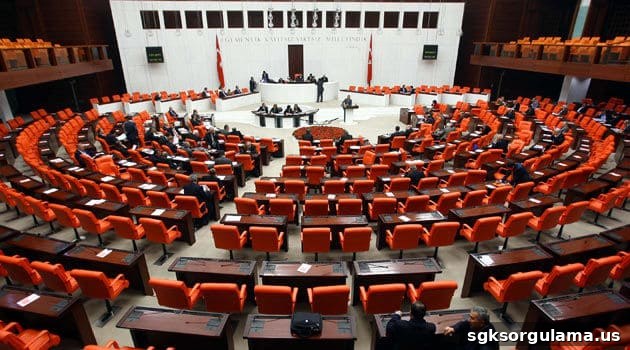
The omnibus bill, like a basic law, aims to bypass some of the slow-moving, cumbersome gears of the general legislative system and expedite lawmaking. This explains the common definition of “omnibus law.”
The new omnibus law on retirement—known as the Draft Law on Amendments to the Labor Law and Certain Other Laws and Decree Laws—was approved by the Grand National Assembly in April 2016. Workers, students and the public in every sector awaited this omnibus law, which entered into force after publication in the Official Gazette. The new omnibus law contains many new regulations across different areas. Provisions related to retirement include measures such as recognizing unpaid General Health Insurance contributions for young people up to age 25 as paid, mandatory vehicle liability insurance for individuals, reconstruction of Diyarbakır’s Sur district after recent conflicts, assignment of 15,000 police officers in 2016, and rules addressing financing of terrorism, among other changes. The package also mentions large projects like Kanal İstanbul and a range of administrative and social policy updates.
Topics Covered by the New Omnibus Law
The highly anticipated omnibus law clarifies early retirement and related provisions.
- Under the new omnibus law, BAĞ-KUR members receive a form of debt relief. According to BAĞ-KUR Law No. 1479, Agricultural BAĞ-KUR Law No. 2926 and the Social Insurances and General Health Insurance Law No. 5510, individuals with BAĞ-KUR premium debts exceeding 24 months to the Social Security Institution (SGK) will have their outstanding debts erased. Corresponding insured periods tied to those debts will also be removed. For example, a BAĞ-KUR member (4/B) who owes 40,000 TL for 10 years would have that 40,000 TL debt forgiven and the related 10-year BAĞ-KUR period erased. Under the previous practice, amnesty applied to those with more than 60 months of debt as of April 30, 2008; the new draft sets that threshold at 24 months.
- The omnibus law will cancel the entire BAĞ-KUR debt for eligible individuals and delete insured periods during which unpaid contributions accrued. If a person also has SSK (employee) insurance, removing the BAĞ-KUR periods eliminates conflicts between SSK and BAĞ-KUR records. Periods where BAĞ-KUR and SSK contributions overlapped—previously invalidating some SSK days—will become legally valid and recognized for insurance purposes.
- After certain BAĞ-KUR periods are deleted, individuals will still need a minimum number of days to qualify for retirement. They will be allowed to reactivate and pay for as many of the removed periods as they wish to reach the required day count. For instance, if a person’s 10-year BAĞ-KUR period is erased and they need an additional three years to retire, they can pay to restore those three years to their insurance record. Under prior rules, an individual with more than 60 months owed to SGK whose debts and insurance periods were removed had to restore all such periods if they wanted them reestablished; the new approach offers more flexibility.
- BAĞ-KUR members with premium debts of 24 months or more will be offered relief if they decide to pay the total principal amount. The unpaid principal amount will be preserved as a fixed sum, and nearly half of the late-payment interest on the unpaid premiums can be forgiven. Borrowers may also be allowed to pay in installments for up to 36 months. For those whose BAĞ-KUR debts are under 24 months, debt forgiveness does not apply; however, employees’ unpaid contribution debts will not be automatically forgiven. In these cases, the state may waive about half of the accrued late-payment interest and provide the option to repay remaining debts over up to 36 months to ease the repayment burden.